

Posted by Olga Sapach
How to Localize Playable Ads for Multiple Markets
A playable ad does not become localized when someone replaces the English copy with translated text. The words may be correct, but the ad can still feel foreign.
The character may look wrong for the audience. The joke may not land. The music may signal the wrong genre. The CTA may sound unnatural. A text label may no longer fit inside the button. A font that worked perfectly in English may fail completely when the creative is exported in Japanese, Korean, Arabic, or Chinese.
And because a playable only has a few seconds to make its mechanic understandable, small localization problems become disproportionately important.
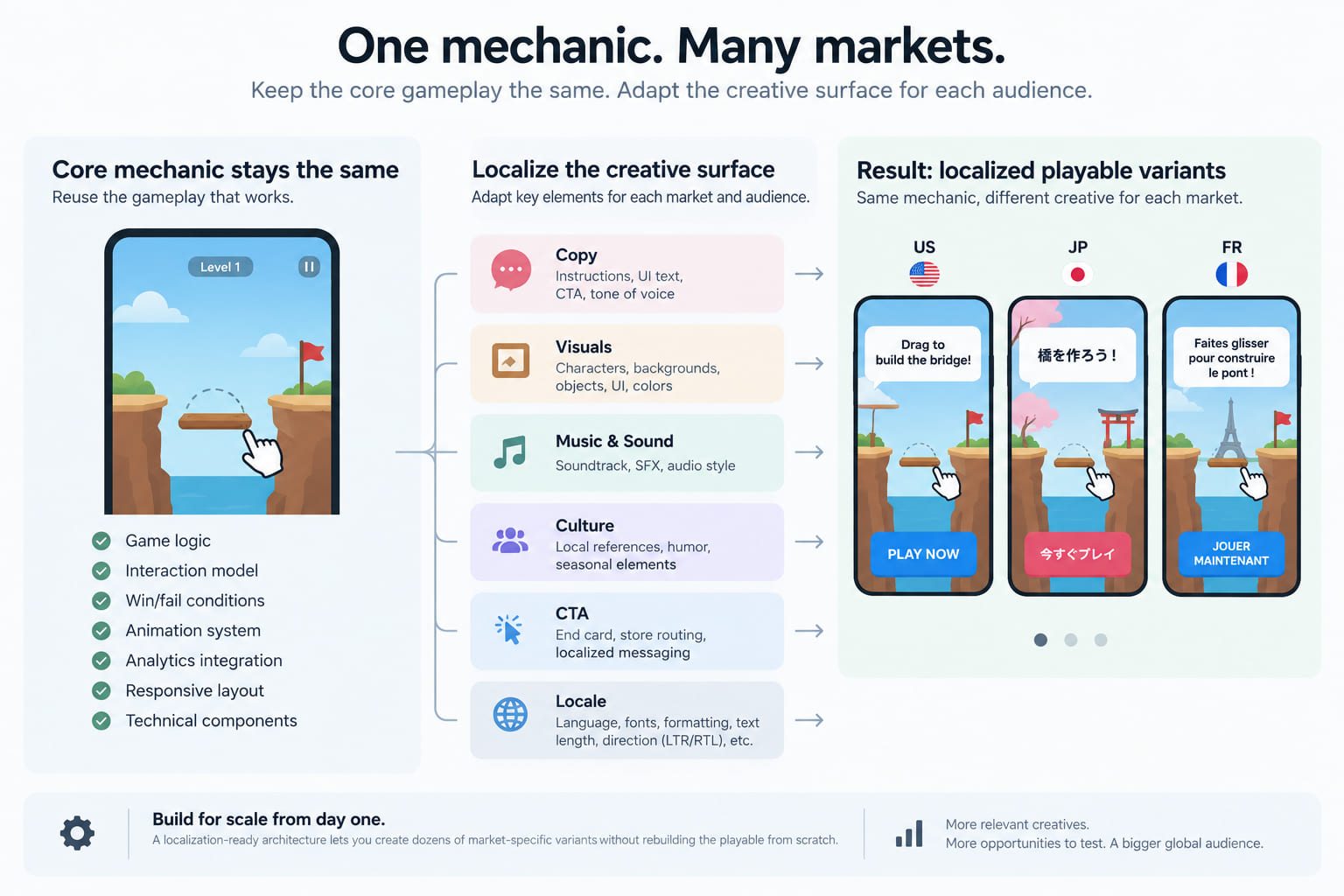
The most scalable approach is not to rebuild the playable from scratch for every market. It is to keep the core mechanic and rebuild the creative surface around it.
That means separating what makes the playable work from what makes it feel relevant to a particular audience.
Playable ad localization is more than translation
Traditional translation asks: what should this text say in another language?
Playable ad localization has to ask a much broader question:
What should this experience feel like to this particular audience?
That can include copy and CTA wording, character treatment, colors and backgrounds, music and sound effects, cultural references, seasonal elements, visual humor, pacing, typography, currency and number formats, and app-store routing.
In some campaigns, the translated text may be the smallest part of the adaptation.
At Alconost, we think about this as keeping the game loop constant while rebuilding the creative surface for a particular targeting segment. The same mechanic can therefore become several substantially different ads without requiring the underlying playable to be developed again.
That distinction is what makes localization scalable.
What should stay the same?
Before deciding what to localize, decide what not to localize.
A successful playable normally has a core interaction: tap the right object; drag something into place; solve a puzzle; choose between two options; upgrade a character; complete a short level; fail and try again.
If that mechanic already works, rebuilding it for France, Japan, Brazil, or South Korea usually creates unnecessary production work.
It helps to think of the playable as two systems stacked on top of each other:
| Layer | What it covers | Across variants |
|---|---|---|
| Mechanic layer what the player does | Core game logic, interaction model, win/fail logic, animation system, analytics hooks, network integration, responsive layout framework, loading logic, reusable technical components. | Reused unchanged |
| Creative layer what the player sees, hears, and reads | Copy, CTA wording, characters, colors, backgrounds, music, sound effects, cultural references, seasonal elements, typography, pacing. | Rebuilt per audience |
The more cleanly those layers are separated during production, the easier it becomes to create ten, fifty, or one hundred localized variants later.
What should you localize in a playable ad?
There is no universal checklist that says every market needs every element changed. Start with the parts that affect comprehension and relevance most directly.
1. Copy and instructions
This is the obvious layer, but playable copy requires more care than ordinary UI translation.
Most playables use extremely short phrases: Tap to play, Choose one, Save her!, Upgrade, Try again, Install now.
There may only be three or four strings in the entire creative. That does not make localization trivial. It makes every string important.
The player has very little time to work out what the ad wants them to do. Awkward translation, an unfamiliar abbreviation, or a CTA written in the wrong register can add friction exactly where the experience needs to feel immediate.
Translate for function rather than word-for-word equivalence. If the English says “Can you beat this level?”, the best version in another language is not necessarily the most literal translation. It is the phrase that creates the same challenge and can still be understood almost instantly.
Keep text outside the code
One of the easiest ways to make localization unnecessarily expensive is to hard-code every visible string throughout the playable. Instead, store text in a localization layer or structured string file. For example: tutorial_1, cta_install, success_message, fail_message, score_label.
That makes it possible to swap a complete language set without searching through production code. It also makes linguistic QA much easier.
2. Text length and layout
English is relatively compact. Another language may need substantially more space to express the same idea. A button designed exactly around PLAY may not survive a localized CTA.
The same applies to speech bubbles, tutorial prompts, score counters, end cards, banners, and button labels.
Do not design text containers around the exact width of the English master. Use flexible layouts and test the longest likely strings early.
A translation that technically fits but has to be reduced to a tiny font size is not a successful localization. The correct solution may be:
- shortening the localized copy;
- allowing a wider container;
- using two lines;
- changing the UI layout;
- replacing copy with a clearer icon where appropriate.
The choice should be made together by the linguist and the creative team.
3. Fonts and writing systems
Fonts are one of the easiest localization problems to discover too late.
Your English playable might contain only a small Latin character set. Then the campaign expands into Japanese. Suddenly the font needs thousands of additional glyphs. Or the design moves into Arabic and needs proper right-to-left rendering and shaping.
The implications are both visual and technical. A localization-ready font strategy should consider supported scripts, readability at small sizes, font-file weight, fallback behavior, line height, punctuation, character shaping, and right-to-left layout where applicable.
This also matters because playable ads operate under strict package-size requirements. Google App Campaign playables, for example, currently allow ZIP packages up to 5 MB and require UTF-8 for non-ASCII characters. Their HTML5 environment also places restrictions on how assets and fonts can be referenced.
Adding an entire CJK font family at the end of production can therefore become both a typography problem and a file-size problem. Plan for target scripts before the master creative is finalized.
4. Visuals
A localized playable does not necessarily need different artwork. But it should at least be reviewed with that question in mind: characters, clothing, food, architecture, symbols, gestures, colors, objects, environments, and UI conventions.
Sometimes a universal visual works perfectly across markets. Sometimes changing one or two elements makes the creative feel far more intentional.
The important point is not to localize visual assets mechanically. Do not replace a background simply because the country changed. Adapt visuals when there is a clear audience or creative reason to do it.
5. Cultural references
This is where localization becomes creative adaptation. A joke that works in one market may need to be replaced entirely in another, and the same applies to memes, celebrity-like archetypes, holidays, sports, fashion, food, slang, internet culture, nostalgia, and music scenes.
Imagine a playable for the same rhythm game. The underlying mechanic might be identical: the player taps notes in time. But the creative surface could be adapted around different audience interests:
- Japan — sakura season, idol aesthetics, Japanese copy.
- South Korea — K-pop-inspired styling, different visual references and music treatment.
- France — a completely different fashion or anime-nostalgia angle.
The mechanic has not changed. The proposition around the mechanic has. This is closer to hyperlocalization than simple translation.
6. Music and sound
Audio is easy to ignore because many playable environments begin muted. But once a user interacts, music and sound effects can become a significant part of the creative.
The same soundtrack may not communicate the same energy to every audience. You might adapt genre, instrumentation, tempo, vocal treatment, sound effects, or musical references.
This does not mean every country needs a stereotypically “local” soundtrack. That usually produces exactly the opposite effect.
The question is: what audio treatment makes sense for this targeting segment and the creative angle we are using?
An audience interested in K-pop is a meaningful creative segment. “People from Korea must like Korean instruments” is not. Localization should be based on actual audience context, not cultural clichés.
7. CTA and end card
The CTA deserves separate attention because it is the moment where the playable stops being a mini-game and becomes an advertisement again. The CTA should be:
- linguistically natural;
- visually clear;
- technically correct;
- appropriate for the target store and platform.
The localized copy also needs to fit inside the end-card layout without damaging hierarchy. If the CTA changes from a compact English phrase to a longer localized version, the button may need to adapt.
Store routing should also be tested in the final production build. The creative may look perfectly localized while still sending the user through the wrong region or store flow.
Do not rely on ad platforms to translate your creative
Localization needs to happen inside the creative-production workflow. Do not assume that selecting another language in the advertising platform will somehow localize the playable itself.
Google explicitly tells App Campaign advertisers that Google Ads does not translate their ads, and recommends targeting languages that correspond to the language actually used by the creative.
That makes the relationship straightforward: campaign targeting and creative language should agree. A Spanish-speaking audience should receive the Spanish creative you intended them to see, not an English playable that happens to be served by a Spanish-targeted campaign.
One multilingual playable or separate localized files?
Technically, it is possible to build a single playable containing several languages. The creative detects a locale or receives a language setting and switches its copy and assets. That can make sense in some environments.
But for performance campaigns, separate localized exports are often easier to work with. Why?
Smaller files
A universal build has to carry assets for multiple languages. Fonts alone can become expensive when several writing systems are involved. Separate exports contain only what each version needs.
Cleaner QA
A French export is tested as a French creative. A Japanese export is tested as a Japanese creative. There is less hidden conditional logic.
Easier campaign management
A specific asset can be mapped directly to a locale, audience, creative concept, targeting segment, or campaign. That makes reporting and asset management easier.
More creative freedom
Once each locale has its own export, localization is no longer limited to replacing strings. The French version can have different graphics. The Japanese version can have different music. The Brazilian version can use a different visual hook. You are not forcing every market into one universal asset package.
Build the master playable for localization from day one
Localization gets expensive when it is treated as something that happens after the playable is finished. A localization-ready master should have clear separation between gameplay logic, text, graphical assets, audio, market-specific configuration, and network-specific configuration.
This makes the playable behave more like a template. The mechanic stays stable. The creative variables can be replaced.
For example, locale = ja-JP might load Japanese strings, Japanese-compatible fonts, a specific background, a specific music track, and localized end-card assets.
Another export can use the same interaction with an entirely different creative surface. The better this architecture is designed at the beginning, the less manual rebuilding is required later.
A practical playable localization workflow
A scalable localization process can be divided into seven stages.
Step 1: Lock the mechanic
Do not localize ten versions of a mechanic that is still changing every day. First decide which interaction is worth scaling. Localization should multiply a useful creative, not multiply uncertainty.
Step 2: Define the target segments
Do not start with “we need 12 languages.” Start with:
Who are the 12 audiences?
Locale and language matter, but they are only part of the targeting plan. Two English-speaking audiences may benefit from completely different creative treatments. A single language may also cover markets where the cultural context differs substantially.
Create a matrix containing at least:
- locale;
- language;
- audience segment;
- creative angle;
- required assets;
- audio treatment;
- CTA;
- network.
Step 3: Prepare localization assets
Extract everything that may change:
- strings;
- images;
- backgrounds;
- characters;
- icons;
- audio;
- fonts;
- end-card elements.
This prevents localization from turning into manual surgery inside the source code.
Step 4: Translate and creatively adapt
Have native linguists review the playable in context. A spreadsheet containing SAVE HER! does not tell the translator what is happening on the screen.
Provide:
- screenshots;
- playable preview links;
- character limits;
- audience information;
- intended emotion;
- CTA context.
For hyperlocalized variants, translators and creative producers should work together rather than sequentially. Sometimes the right answer is not a better translation. It is different copy.
Step 5: Generate localized builds
Apply the localized assets to the shared mechanic. At this stage, test:
- string length;
- fonts;
- line wrapping;
- aspect ratios;
- audio;
- asset weight;
- orientation;
- CTA placement.
Also check package size after localization. A master build that was comfortably under the network limit can become much larger after a new font or localized audio track is added.
If you need the current limits for Meta, Google, TikTok, Unity Ads, AppLovin, and other networks, see our guide to playable ad file size limits.
Step 6: Native-speaker QA
Machine translation or linguistic review outside the creative is not enough. A native speaker should see the final playable. They should check:
- whether the copy sounds natural;
- whether it makes sense in context;
- whether anything is truncated;
- whether the register fits the audience;
- whether cultural references work;
- whether the visual treatment feels intentional;
- whether the CTA is clear.
At Alconost, localized playable variants include native-speaker QA as part of the production workflow.
Step 7: Test the actual network exports
Do not stop after checking the master build. The final Meta, Google, TikTok, Unity Ads, or AppLovin package is the creative users will actually receive. Test that file. Check:
- load behavior;
- text rendering;
- orientation;
- sound;
- CTA behavior;
- store routing;
- final package size.
Localization QA and network QA should meet at this stage.
Translation vs hyperlocalization
Not every campaign needs complete creative adaptation. It helps to think of localization in levels.
| Level | What changes | Best when |
|---|---|---|
| 1. Translation | Visible copy, the CTA, end-card text. | The original creative is already culturally neutral. |
| 2. Localization | Copy, typography, selected graphics, UI details, and audio where necessary. The mechanic stays unchanged. | The creative reads as foreign without adaptation, but the idea still travels. |
| 3. Hyperlocalization | The entire creative surface around a specific audience segment: copy, palette, imagery, music, cultural references, characters, seasonal treatment, pacing. The underlying mechanic still stays reusable. | The audience segment, not just the language, is what you are targeting. |
The appropriate level depends on the campaign. There is no reason to rebuild an entire creative if translated copy is enough. And there is little value in technically correct translation if the whole creative still feels irrelevant to the audience.
How many localized playable variants do you need?
There is no universal number. A useful way to think about it is:
markets × meaningful audience segments × creative angles
Suppose you run one mechanic in five markets. If each market only needs one language adaptation, that might mean five variants. But if you have two audience segments per market, two visual treatments, and one seasonal refresh, the number grows quickly.
This is why localization architecture matters. At a handful of versions, almost any workflow works. At fifty or one hundred variants, manually rebuilding every playable becomes a production bottleneck.
Alconost’s current playable production model is designed around this kind of scale. A polished mechanic can be rerendered for individual targeting segments, with copy, music, visuals, cultural register, and other creative elements rebuilt around the same interaction. Localized variants are currently priced at $250 per variant, with native-speaker QA included.
The important idea is not simply that localization becomes cheaper. It is that the cost of testing another audience becomes predictable.
Common playable localization mistakes
| Mistake | Why it hurts | Do this instead |
|---|---|---|
| Translating after the layout is finished | If every text container was designed around English, localized versions will immediately start breaking. | Design flexible layouts from the beginning. |
| Hard-coding copy | This turns every localization update into a developer task. | Keep strings separate from interaction logic. |
| Using one font without checking target scripts | A beautiful Latin display font is irrelevant if it cannot render half your target markets. | Decide script coverage early. |
| Treating localization as country stereotypes | Adding cherry blossoms to Japan and the Eiffel Tower to France is not a localization strategy. | Creative adaptation should follow the target audience and campaign idea. |
| Forgetting audio | Localized copy paired with a completely mismatched voice, music, or sound treatment can make the ad feel less coherent, not more. | Decide the audio treatment alongside the copy, not after it. |
| Ignoring file size | New fonts, images, and audio increase payload size. | Measure the final localized export rather than assuming it weighs the same as the master. |
| Skipping native QA | A translation can be linguistically correct and still be wrong in the ad. | Review the experience, not just the strings. |
| Creating too many unique codebases | If every locale becomes an independent development branch, maintaining the campaign becomes expensive quickly. | Reuse the mechanic wherever possible. |
Frequently asked questions
What does playable ad localization include?
Playable ad localization can include translation, CTA adaptation, fonts, visual assets, music, sound effects, cultural references, end cards, and audience-specific creative treatment. The exact scope depends on how different the target creative needs to be from the master version.
Is playable ad localization the same as translation?
No. Translation changes language. Localization adapts the creative for a specific market or audience. In playable advertising, that can involve visuals, audio, typography, cultural references, and other parts of the experience in addition to text.
Do I need to rebuild a playable ad for every language?
Usually not. A well-structured playable can reuse the same game logic and mechanic while swapping language and market-specific assets. Separate final exports can then be generated for each target segment.
Should one playable contain all languages?
It can, but separate locale-specific builds are often easier to optimize, QA, measure, and customize. They also avoid packaging unnecessary fonts and assets into every version.
How do you localize playable ads for Japanese, Chinese, or Korean?
Plan font coverage and text rendering early. CJK scripts require significantly larger character sets than English, and localized typography can affect package size. Text containers should also be tested using the real translated strings rather than English placeholders.
Should music and visuals be localized too?
Only when there is a creative reason. The goal is not to change everything for every market. Music and visuals should be adapted when doing so makes the creative more relevant to the target audience or campaign angle.
How much does playable ad localization cost?
Alconost currently charges $250 for a localized or audience-specific variant within a playable-ad engagement. A variant can involve more than translation: copy, visuals, music, cultural register, and other creative elements can be rebuilt while the core mechanic is reused.
How do you QA localized playable ads?
Review the final build with a native speaker and then test the actual network-specific export. Check language, layout, fonts, cultural context, orientation, audio, CTA behavior, store routing, and package size.
Localize the creative, not the codebase
The goal of playable localization is not to produce the same ad twenty times. It is to build the playable once in a way that allows the parts users actually perceive to change.
Keep the mechanic stable. Make text replaceable. Make visual and audio assets modular. Plan fonts and layout for multiple scripts. Then let each market or targeting segment have the creative surface that makes sense for it.
That turns localization from a final translation task into part of the UA creative system.
At Alconost, a polished playable can be scaled into localized and audience-specific variants while retaining the underlying mechanic. Copy, visuals, music, cultural cues, and other elements can be rebuilt for each targeting segment, with native-speaker QA included.
If your UA team needs to turn one working playable mechanic into dozens of market- or audience-specific creatives, explore Alconost’s playable ad production workflow.
Related articles
Popular articles
Voiceovers in 14 languages for the Kerish Doctor software
Success stories
Voice Over
5 minutes read
Character voiceovers in Spanish and Brazilian Portuguese for the RPG Life is Feudal: Your Own
Success stories
Voice Over
5 minutes read
How Much Does an Animated Explainer Video Cost? Explore the figures!
Video Production
4 minutes read
Latest articles
How Much Does a Playable Ad Cost to Produce?
Playable Ads
13 minutes read
Playable Ad File Size Limits by Network: 2026 Guide
Playable Ads
15 minutes read
How to Create an Engaging and Easy-to-Watch Explainer Video
Video Production
10 minutes read
Have a project in mind?
We’d like to learn more about it. In return, we’ll get back to you with a solution and a quote.
Looking for a new job? Apply here!